The Great Divide by William D. Gairdner
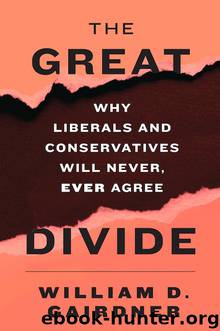
Author:William D. Gairdner [Gairdner, William D.]
Language: eng
Format: epub
ISBN: 9781594037658
Publisher: Encounter Books
13The quotes by Arrow and Mankiw and many of the details and arguments on income inequality presented here, which I hope I have reflected accurately, are taken from Chris Sarlo, The Economic Well-Being of Canadians: Is There a Growing Gap?
CHAPTER 11
On Morality and the Self
The single most important moral question in the entire premodern period centered on how people are to achieve moral excellence as described in religion, philosophy, the law, and heroic legends of culture. In general, the call was for integrity of character, and this did not mean merely abstaining from harm to others. That was taken for granted. Rather, it meant the exertion of personal and communal effort to achieve the good. The big moral question until very recently was, how ought we to live as a people?, with the emphasis on we, not me. There was general agreement that those who try to substitute the latter for the former are guilty of trying to turn the natural world upside down. To run afoul of the communal standard of the good was to feel a deep shame and personal unworthiness.
Shame and unworthiness! Do we hear such confessions today? On the contrary. We are more likely to hear about how to pump up our “self-esteem.” But not so long ago even a schoolboy would have said this is a twisted ideal, because esteem is something we earn from others through estimable actions; it cannot originate in ourselves except as self-congratulation. The ultimate question has never before been how, as individuals, we are to evaluate moral principles, but rather, because the great moral principles precede our existence and reflect a moral tradition and consensus of the community: In what ways can I uphold those principles, and how will I be judged in their light?
This question has all but disappeared in recent times. We are far more likely to witness individuals adjusting their moral principles to suit their personal circumstances or point of view, or judging the moral views of their own community negatively, rather than feeling judged by them. In the infamously relativist 1960s, “situational ethics” was all the rage in the schools, and by the ’80s, “moral values education” (or “values clarification”) was widely taught by morals educators. The underlying thesis was that in order for moral principles to be legitimate (morally binding), you had to reason your way to them yourself.14
Many educators have backed away from that approach since the turn of this century, but the effects have lingered. Hume would have described values clarification as a “moral inversion,” whereby we judge the moral laws, instead of being judged by them. Conservatives got very angry about this trend, charging that values clarification education, then and now, undermines a moral community. For a moral principle that has worked well over the ages ought to be followed, whether or not we have personally managed to reason it out for ourselves. As previously stated in On Reason, stand-alone reason is not always a guide to the good. It tends to produce rationalizations of personal desires, rather than any good for others.
Download
This site does not store any files on its server. We only index and link to content provided by other sites. Please contact the content providers to delete copyright contents if any and email us, we'll remove relevant links or contents immediately.
| Anthropology | Archaeology |
| Philosophy | Politics & Government |
| Social Sciences | Sociology |
| Women's Studies |
The Secret History by Donna Tartt(19460)
The Social Justice Warrior Handbook by Lisa De Pasquale(12290)
Thirteen Reasons Why by Jay Asher(9110)
This Is How You Lose Her by Junot Diaz(7053)
Weapons of Math Destruction by Cathy O'Neil(6460)
Zero to One by Peter Thiel(5937)
Beartown by Fredrik Backman(5927)
The Myth of the Strong Leader by Archie Brown(5623)
The Fire Next Time by James Baldwin(5578)
How Democracies Die by Steven Levitsky & Daniel Ziblatt(5321)
Promise Me, Dad by Joe Biden(5228)
Stone's Rules by Roger Stone(5184)
A Higher Loyalty: Truth, Lies, and Leadership by James Comey(5080)
100 Deadly Skills by Clint Emerson(5023)
Rise and Kill First by Ronen Bergman(4890)
Secrecy World by Jake Bernstein(4864)
The David Icke Guide to the Global Conspiracy (and how to end it) by David Icke(4841)
The Doomsday Machine by Daniel Ellsberg(4613)
The Farm by Tom Rob Smith(4598)
